
Preparing Responders for the Worst, So They Perform at Their Best.
The system originated at The Ohio State University and was developed with grant support from DARPA and its partners. DARPA has expressed strong interest in seeing this technology move beyond research and into real-world civilian use, where it can directly strengthen responder readiness and save lives.
Virtual Mass Casualty Reality Training System
Key Features:
Immersive Scenarios
Experience true operational chaos,
Train with realistic patient behaviors,
Build confidence in high-pressure environments
AI Patient Dialogue
Fully interactive natural-language conversations
AI-driven responses
Authentic recorded voices and dynamic dialogue,
SALT, START, TCCC Training & Hemorrhage Control
Built around top methodologies,
train SALT, START, and TCCC in one integrated VR platform.
Provides a clearer, more medically accurate decision process
to prioritizes early hemorrhage control and rapid risk assessment.
Reduces common triage errors
and builds reliable habits for high-risk, low-frequency events.
Supports ongoing national evaluation and state-level adoption,
aligned with evolving triage standards, including Ohio’s move to SALT.
Delivers consistent, evidence-based training
through one standard curriculum across civilian, military, and hospital teams.
Real‑Time Toolkit
Hands-on hemorrhage control tools,
Burn assessment and burn control,
Airway management actions such as opening the airway,
Dynamic triage tagging using SALT-based color categories,
Patient assessment cues,
Environmental interaction tools
Auto Analytics
Objective performance scoring
Automated after-action reports
Randomized challenges
CE-ready documentation
Portable & Flexible
Instructor-led or fully self-guided,
No simulation lab or IT staff required,
Lightweight and mobile,
Why VR Training?
Cost Savings:
- Replaces $10,000–$100,000 full-scale drills with realistic, repeatable VR scenarios that require no large-scale setup.
- Drops training costs to roughly $10–$30 per user per hour, making high-quality MCI training affordable for any department.
- Eliminates major expenses like facility rentals, actors, moulage, props, and overtime staffing.
- One VR kit (≈ $1,200) can deliver the same training value as $20,000–$80,000 worth of mannequins, gear, and simulation equipment.
Performance Advantages:
- Unlimited scenario repetitions, allowing responders to practice until they master triage and hemorrhage-control skills.
- Improves skill acquisition by 30–40% compared to traditional classroom or lecture-based instruction.
- Delivers consistent training across entire departments, regions, and multi-agency partners, no matter the staffing or schedule.
- Automated performance tracking captures decisions, timing, and accuracy so supervisors can measure competence and identify gaps.
- Dashboards and performance reports
- Supports documentation, CE requirements, and standardized assessment
Operational Efficiency:
- Train during normal shift hours without disrupting operations or fighting for limited training windows.
- Scales to any department size, from small volunteer squads to large urban systems.
- Runs anywhere stations, classrooms, offices, or drill grounds, with no need for a simulation center or specialized space.
- Ideal for rural and under-resourced agencies, providing high-quality training without the infrastructure or staffing burden.
Scalability:
- One VR headset can train dozens of responders each week, keeping skills sharp without adding instructors or overtime.
- Easily deployable across regions and entire states, allowing training councils and statewide systems to standardize MCI readiness across multiple agencies.
- Built for cross-disciplinary use, supporting EMS, fire, hospitals, law enforcement, and military medical units with a single unified platform.
Who We Serve

Fire & EMS
Delivers consistent, repeatable training so every member,regardless of shift, staffing, or call volume gets the same high-quality MCI and hemorrhage-control practice without scheduling a full-scale drill.
Cuts training costs and resource demands, reducing the need for overtime, props, multi-agency coordination, and large training grounds while still giving crews realistic, stress-based scenarios.
Builds measurable skills and confidence, providing objective performance data so departments can identify gaps, track improvement, and ensure responders are ready for real-world mass-casualty events.

Hospitals
Strengthens surge capacity and emergency department readiness, allowing hospital teams to practice rapid triage, patient flow, and communication during high-volume mass-casualty scenarios.
Helps meet accreditation and compliance requirements by providing repeatable training modules that support Joint Commission, CMS, and internal disaster-preparedness standards.
Improves coordination across departments, enabling ED, trauma, ICU, security, and incident command staff to rehearse their roles together without the cost, disruption, or logistics of full-scale disaster drills.
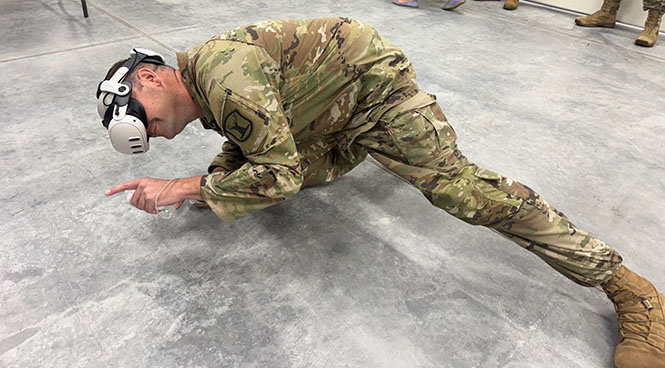
Army, Navy, Air Force, Coast Guard,
National Guard & Joint Forces Training
Replicate joint-operations mass-casualty conditions with scalable scenarios that train medics, security forces, and support units under realistic stress, without the cost of full-scale field exercises.
Strengthen interoperability across partner agencies, allowing units to rehearse unified triage, communication, and casualty movement procedures before live drills.
Improve readiness and deployment preparedness with data-driven performance tracking that identifies strengths, gaps, and required remediation long before mobilization.

Medical Simulation Centers
Expands their training catalog, giving the center a high-demand MCI and triage module that attracts EMS providers, nursing programs, residency programs, and hospital partners looking for advanced simulation options.
Drives new revenue through bookings, helping the center increase utilization by offering a modern, VR-based alternative to expensive, labor-intensive mass-casualty drills.
Integrates seamlessly with existing sim infrastructure, allowing centers to layer VR into their mannequins, skills labs, and standardized patient programs without adding major overhead or staff burden.
Provides measurable competency data, giving educators and program directors clear performance metrics that support curriculum development, accreditation reporting, and continuous improvement.
Common Use Cases for the VR Mass Casualty Training System
- Mass-casualty incident (MCI) triage training for EMS, fire, police, and hospital teams.
- Hemorrhage control and lifesaving intervention practice using realistic, stress-based scenarios.
- Disaster response preparation for events like industrial accidents, structural collapse, or transportation emergencies.
- Active shooter and hostile-event medical response with controlled, repeatable simulation environments.
- Hospital surge training for trauma bays, ED teams, and in-hospital rapid triage workflows.
- Interagency coordination practice, including EMS–fire–police–hospital communication during MCIs.
- Military medic and corpsman readiness training that mirrors battlefield triage and casualty management.
- Remote or rural responder training where hands-on drills are difficult or cost-prohibitive.
- New responder onboarding to build baseline triage decision-making skills before live drills.
- Annual recertification and competency assessments using objective, measurable performance data.
- After-action review and skill remediation, allowing agencies to replay scenarios and correct mistakes.
- Training for volunteer departments where staffing limits make large in-person MCI drills impossible.
- Leadership and command-level training for incident commanders managing multi-casualty scenes.
- Preparedness exercises for hospitals and healthcare networks required for accreditation or compliance.
- Continuing education credit-based modules integrated with state or departmental CE systems.
Our system has already trained more than 700 responders across the country, with deployments to hospitals, EMS teams, universities, and military units. The results have been overwhelmingly positive, with high ratings for realism, usability, and confidence gained.
© 2025 Tactical Triage Technologies · Columbus, Ohio · All rights reserved.